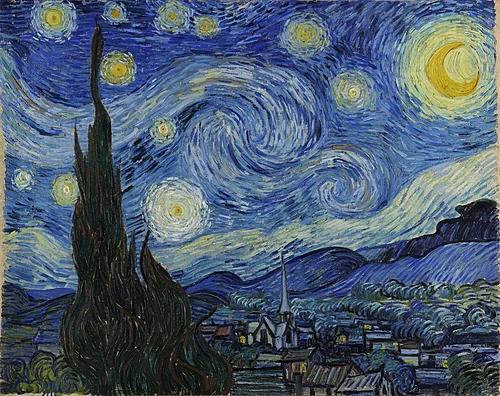
Vincent van Gogh created his most famous landscape while looking back on his life and thinking about death.
He painted The Starry Night in June 1889 — just 13 months before his death — while staying at the Saint-Paul psychiatric hospital in Provence. The exact nature of his mental illness is still debated today.
Van Gogh’s condition worsened dramatically at the end of 1888 after a falling-out with his friend Paul Gauguin. Van Gogh dreamed of creating a brotherhood of artists, but the plan collapsed. The two worked together for only five weeks before their constant clashes boiled over. After one particularly intense argument, Van Gogh suffered a breakdown and cut off part of his ear.
How The Starry Night came to be
Unlike most of Van Gogh’s landscapes from that period, The Starry Night was conceived as an “abstraction.” That’s how Gauguin — whose influence on the painting was strong — described works painted not from direct observation, but from imagination.
The endless night sky made Van Gogh think about the infinity of life, while the countless stars reminded him of other possible worlds. At the center of the scene, he placed a Dutch-style church — a metaphor for feeling like an outsider in Provence and a symbol of Christian dogma, which Van Gogh had moved away from. The church’s steeple reaches into the star-filled sky, pointing toward a life beyond Earth.
9 key details in The Starry Night
1. The steeple
The church, with architecture resembling Dutch churches, standing in the middle of a Provençal village reflects Van Gogh’s memories of his early life. The son of a Dutch pastor, Van Gogh had grown disillusioned with organized Christianity by this point, but spirituality and a personal connection with God remained central themes in his thoughts, letters, and art.
2. The cypress trees
Since ancient times, cypress trees have been planted in cemeteries, which is why they’re associated with death in European culture. Van Gogh called them “the most characteristic feature of the Provençal landscape.” He mentioned the cypress from The Starry Night in letters and painted it repeatedly in other works and sketches, often comparing the tree to a candle flame.
3. Vertical lines
The cypress and the church steeple are the only vertical elements in a composition built almost entirely on flowing horizontal lines. The shape of the cypress mirrors the church tower. Like the steeple, the cypress — a symbol of both death and eternal life — reaches upward toward the stars.
4. The stars
Van Gogh compared stars to destinations on a map: “Just as we take the train to Tarascon or Rouen, we take death to reach the stars.” For an artist who had lost faith in religion, stars became a symbol of connection with God.
5. Venus
At the time, Venus was shining especially brightly in the night sky, something Van Gogh mentioned in a letter to his brother. Since the Renaissance, Venus (Aphrodite in ancient mythology) symbolized love in European art — one of Christianity’s core virtues. Given Van Gogh’s deep knowledge of both classical texts and the Bible, the idea that the bright planet represents God’s loving gaze feels especially convincing.
6. The village
Although the composition is imagined, Van Gogh based it on sketches he made while walking around the hospital and the nearby town of Saint-Rémy-de-Provence. The rolling hills, houses, and cypress trees were assembled from different views — it would have been impossible to see them all from one single spot.
7. Texture and brushwork
Art historian Ernst Gombrich once said that the boldness and speed of Van Gogh’s brushstrokes helped convey the “exalted state of his soul.” The thick, broken strokes and swirling forms are typical of Van Gogh’s work after his mental health declined.
8. Yellow and blue
Yellow and blue are the two dominant colors in The Starry Night and many of Van Gogh’s other masterpieces, including Café Terrace at Night (1888). For Van Gogh, yellow symbolized wheat and sunlight, while blue stood for night. Together, they represented life and death. As he wrote in one letter, “There is no blue without yellow and orange.”
9. Complex color
While blue-and-yellow contrasts are typical for Van Gogh, the color palette here is unusually complex. Bold strokes of light and dark paint, warm and cool tones placed side by side, create a sense of movement and turbulence. Gauguin believed the “powerful, full-sounding color chords that form the overall harmony” showed his influence — something Van Gogh didn’t deny. He described the painting as a visual continuation of their conversations.