Spring moves across the map — from Jeju Island to the lakes of Gangneung
Spring in South Korea isn’t just a season — it’s a journey shaped by nature itself. From late March to mid-April, a slow wave of blossoms travels from south to north, turning the country into a living painting: golden rapeseed fields on Jeju, cherry-lined streets in Seoul, and soft pink hillsides along the eastern coast of Gangneung.
We’ve mapped out Korea’s spring in detail — with cities, precise dates, hidden spots, and festivals — so you can be in exactly the right place at the right moment. Step onto the blooming path.
Where and When to Find Spring in Korea
Unlike Europe, where blossom season often feels like a gamble, Korea follows a clear and elegant pattern. Spring moves downward on the calendar and upward on the map: first Jeju, then the southern cities, followed by Seoul and the eastern lakes. Blossom-chasing here can be planned almost like a flight itinerary.
Even if you miss peak bloom in one place, there’s always another where the cherry trees are just beginning to open. We’ve gathered the key stops along this route — from the first petals to the final pink clouds.
Jeju Island: The Road to Hallasan and Coastal Drives
Best time to visit: approximately March 22–30
The journey begins on an island, because spring arrives in Korea here first. On Jeju, delicate royal cherry blossoms bloom early, while vast fields of rapeseed paint the roadsides in bold yellow strokes. Mount Hallasan rises on the horizon, sea winds tousle your hair, and the light feels softer — a quiet promise that you’re ahead of the season.
Tip: Rent a car. Jeju’s most beautiful routes run through rural roads, and don’t miss sunrise — in the early light, the rapeseed fields glow like gold.
Jinhae (Changwon): Gyeonghwa Station and Yeojwacheon Stream
Best time to visit: late March to early April
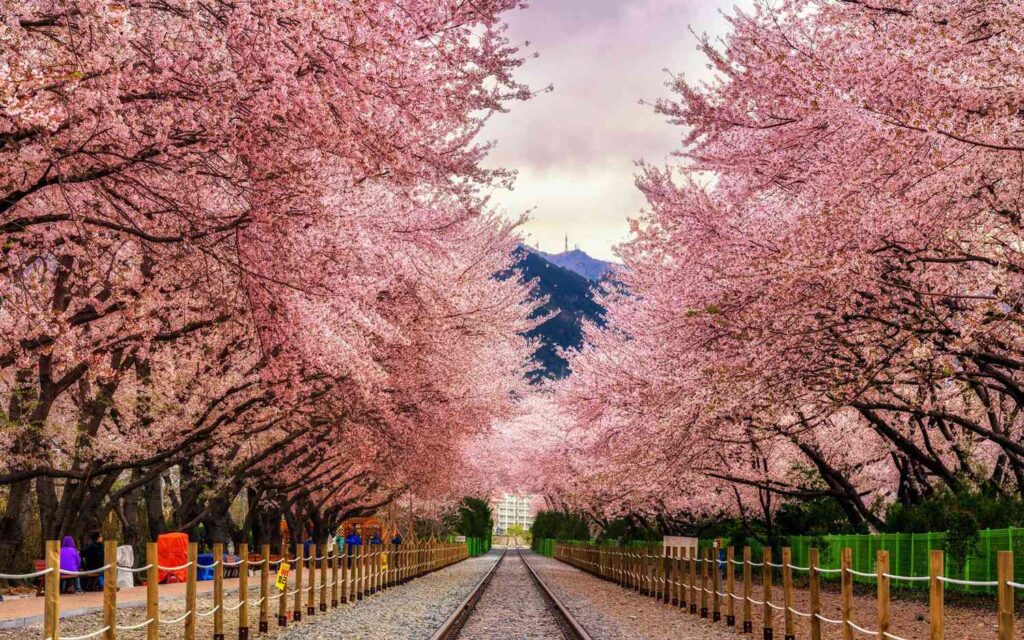
Jinhae is the heart of Korean spring. Here, cherry blossoms don’t just bloom — they celebrate. Tree-lined paths stretch along old railway tracks and glowing evening streets; petals fall like snow, and every scene feels cinematic. Along Yeojwacheon Stream, pink canopies ripple in the water, moving gently with the city’s rhythm.
Tip: Arrive at dawn, before the crowds wake up, when the sky is just turning pink. Plan ahead — Jinhae gets busy during bloom season.
Gyeongju: Bomun Lake and the Tumuli Park
Best time to visit: approximately March 30 – April 5
Once the capital of the Silla Kingdom, Gyeongju is where spring meets antiquity. Cherry trees scatter their petals along Bomun Lake, reflected in still water, while nearby lie royal burial mounds and ancient stone walls. Time moves differently here — even the falling petals seem slower.
Tip: Visit on a weekday and come to the lake before tour buses arrive. Locals call this the “quiet hour of blossom viewing.”
Seoul: Gyeongbokgung Palace and Namsan Mountain
Best time to visit: approximately March 27 – April 3
Spring enters the capital with ceremony. Along Gyeongbokgung Palace, cherry trees bloom against tiled hanok roofs and the formal silhouettes of palace guards in traditional dress. A walk up Namsan Mountain offers a view where petals blend into the city skyline.
Tip: Sunrise is best — fewer tourists and perfect light for photos.
Gangneung: Gyeongpo Lake and Seongyojang Temple
Best time to visit: approximately April 2 – 8
On Korea’s east coast, cherry blossoms meet the sea breeze. Gyeongpo Lake acts like a mirror, doubling the beauty of blooming trees. Nearby, Seongyojang Temple feels modest yet mesmerizing, framed by pink petals and deep green pines. This is a place not for ticking boxes, but for quiet discovery.
Tip: Walk from the lake to the temple along the shore — about an hour, filled with unforgettable views.
Jeonju: Hanok Village and Deokjin Park
Best time to visit: approximately March 30 – April 6
Here, cherry trees rise against wooden houses with curved roofs, turning the hanok village into a stage where spring performs at its best. In Deokjin Park, locals gather in the evenings for blanket picnics, fruit baskets, and soft Korean melodies. Jeonju is aesthetic, flavorful, and perfectly suited to slow living.
Tip: Try the traditional 10–12-dish meal set — spring here is also a culinary experience.
Hwaeomsa Temple and Jirisan Mountains
Best time to visit: approximately April 5 – 12
High in the mountains, far from city noise, spring arrives gently. Blossoms unfold slowly in Jirisan, and Hwaeomsa Temple seems to float among clouds, surrounded by cherry trees and ancient pines. This is a place for clarity, calm, and being alone with your thoughts.
Tip: Bring a jacket — nights are cooler here, especially early in the morning or late in the evening.
Korea’s Spring Festivals
Spring in Korea also comes with street music, the scent of roasted chestnuts, paper lanterns in the sky, and cherry petals dancing in the air. Each city celebrates renewal in its own way.
Jinhae Cherry Blossom Festival
Where: Jinhae District, Changwon
When: approximately March 25 – April 3
What to expect: over 300,000 cherry trees along the Yeojwacheon Stream, Romance Bridge, nighttime illuminations, and sea air
Tip: Visit on a weekday and explore the festival’s edges — fewer crowds, more space to breathe.
Jogyesa Temple Lantern Festival
Where: central Seoul, near Insadong
When: mid-April, around Buddha’s Birthday
What to expect: colorful paper lanterns, spiritual rituals, food, and hands-on workshops
Tip: Stay until dark — as the lanterns light up one by one, the city seems to pause in their warm glow.
Spring in Korea isn’t a season — it’s a state of mind. Mountains slip into dusty-pink shawls, rivers become mirrors for blooming alleys, and the air smells of rice cakes and floral tea. It’s a time to walk slowly, look far ahead, and speak softly, as if afraid to disturb the beauty around you.
You can see Korea on screen — or you can discover it in real life: with temples where bells ring in the wind and narrow streets buried in petals.
Set out on an unforgettable journey toward spring. It’s already waiting for you — in the very heart of Korea.