
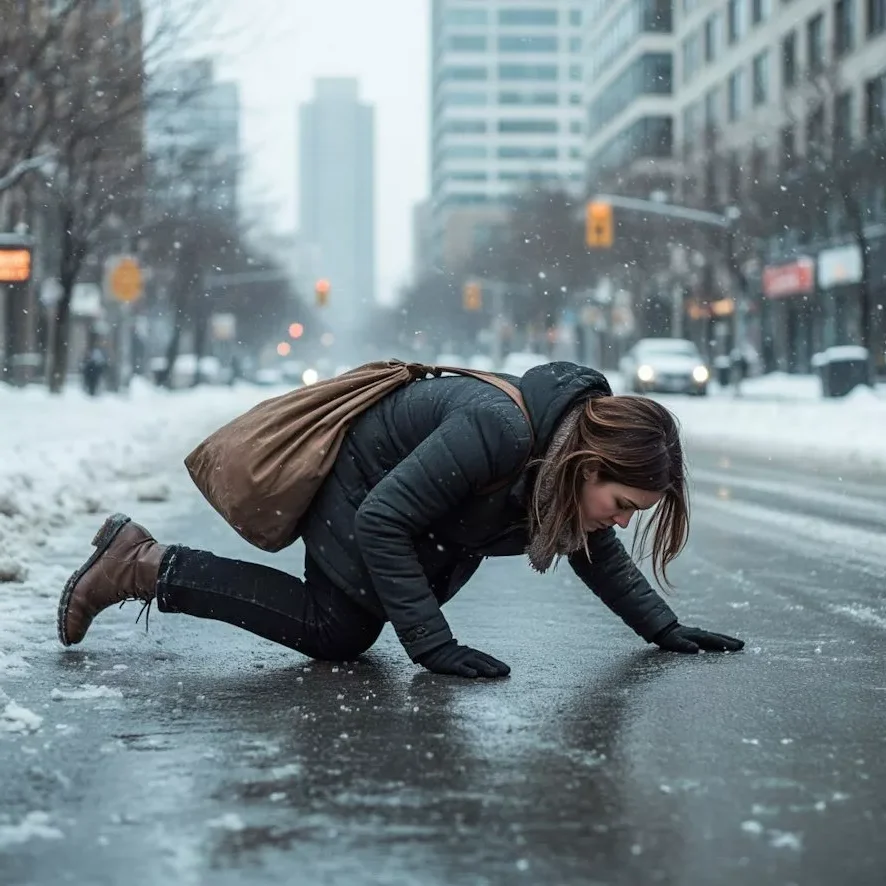
It turns out that falling is almost a science. And falling from your own height incorrectly can be nearly as destructive as a minor car accident.
Falling Breakdown: Choosing Your Injury
Have you ever thought that the direction of your fall toward the ground is basically choosing your future medical story? An expert laid out the options like a menu in a trauma restaurant.
Falling on your side. It may seem better than falling on your back. Not really. Landing on your shoulder or side is a direct path to a broken humerus or fractured ribs. And since your leg is usually doing something awkward at that moment, you might also get a sprain or ankle fracture. A combo, so to speak.
Falling on your back. Now this is serious. Hit the back of your head — welcome to the world of traumatic brain injuries. Land on your buttocks or lower back — prepare to meet compression fractures of the vertebrae or a tailbone injury, the memory of which will stay with you for a long time. The most epic failure, literally.
Falling forward. Here an ancient instinct betrays us — to put out our hands. And this is a fatal mistake. The entire weight and energy of the fall hits fragile wrists and elbows. The result is the classic distal radius fracture in the “typical location” (traumatologists know it very well), a shoulder dislocation, or a broken collarbone. Hands are for hugs and phones, not for absorbing the impact of a fall from human height.
Elderly people are a special case — for them, icy conditions are not a joke but a direct threat to independent living. Osteoporosis makes bones fragile like old porcelain. Falling sideways with impact on the hip often ends with a hip fracture — an injury that can change life permanently and for a long time, if not forever.
The Philosophy of Falling Correctly: Tuck, Relax, Roll
The scientist’s main conclusion sounds paradoxical: to avoid injury, you need to accept the impact properly. Do not resist the fall — lead it. The goal is not to fall like a stiff board, but to turn a hard point impact into a series of soft rolls, distributing the load.
Here is the algorithm worth remembering like an emergency phone number:
Admit defeat. As soon as you realize the balance is gone, stop waving your arms frantically. Accept it. Psychological readiness is the foundation of everything.
Tuck in. Quickly bend your knees (try to squat slightly to reduce the height of the fall), press your chin to your chest to protect your head. Elbows to your sides, legs together. Whatever is in your hands (bag, phone, groceries) — throw it away immediately. You can buy new things; a cast is more expensive.
Fall and roll. The ideal scenario is to fall on your side and then roll onto your back. The impact is absorbed by the side of the thigh, buttock, and shoulder blade — the most cushioned parts of the body. The roll dissipates the energy. Even if you cannot roll, falling sideways is safer for the tailbone and spine than falling flat.
For elderly people this technique is often difficult due to slower reaction time. The expert gives them three simple tips:
- Choose a safe route and use a cane with a rubber tip;
- At the moment of falling, focus on one thing — tuck your head to your chest;
- Relax. Tense muscles and bones break more easily.
After the Fall: Don’t Jump Up Immediately
The most common mistake after an unpleasant landing is to jump up quickly out of embarrassment or pain. This should absolutely not be done. Sudden movement can worsen a hidden fracture or displacement.
What to do after a fall:
- Freeze. Do not move for a few seconds. Listen to your body.
- Assess the damage. Sharp pain, inability to move a limb, visible deformity, rapidly increasing swelling — these are warning signs. Numbness in arms or legs is especially dangerous.
- Get up carefully. If there is no severe pain, stand up slowly, first onto your knees and hands, then carefully onto your feet.
A special case is a head impact. Nausea, dizziness, disorientation, unequal pupil size — these are signs of a possible concussion. In this case, the person should not be left alone or allowed to drive. They need rest and immediate medical attention.
Prevention: Penguins Rule the Ice World
The best fall is the one that never happened. Here the scientist suggests learning from Antarctic masters of walking on ice.
“Penguin walk”: Lean your body slightly forward, walk with small shuffling steps, placing your foot flat. Knees slightly bent. Forget wide steps and proud posture. The most cautious survives here.
Shoes are your armor. Wide soles with deep tread and soft rubber are your best friend. Leave high heels for warm office floors.
Keep your hands free! Hands in pockets are like a monkey without a tail for balance. Keep them free so you can tuck or balance if needed.
Caution is the mother of order. Stairs, curbs, and getting off transport are high-risk zones. Hold onto railings. Elderly people should consider whether a trip outside during heavy ice is really necessary.
So, to summarize the scientist’s findings: icy conditions are not a natural disaster but an exam in coordination and self-control.
Our instincts (putting hands out, leaning back) are our enemies. Safety lies in a controlled fall: tuck your head, group your body, and try to fall sideways with a roll.
For elderly people, the key word is prevention: a cane, a safe route, and maximum caution.
And remember: there is nothing embarrassing about walking on ice like a penguin. What’s bad is lying in a cast thinking it could have been avoided. Take care of yourself, and may your falls be only into the arms of loved ones.