But losing money is even easier. We explain why memecoins have become so popular and what “financial nihilism” has to do with it.
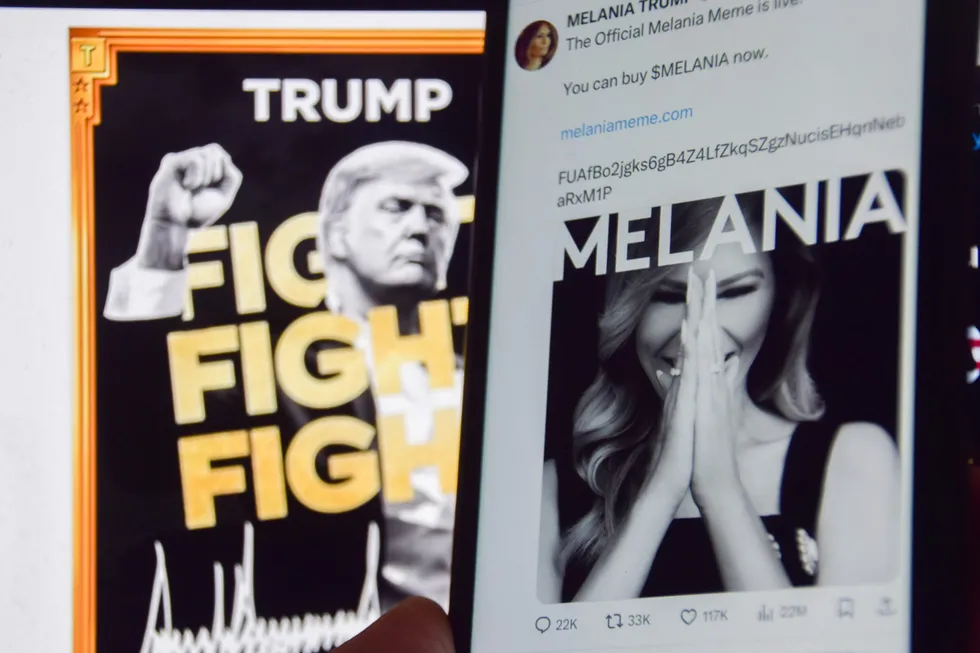
In January, on the eve of the inauguration, U.S. President-elect Donald Trump, followed by his wife Melania, launched their own memecoins. This is what digital assets are called that were originally created as a joke but soon fascinated investors so much that interest in cryptocurrency reached its highest level in the past three years. Meduza explains how joke coins became the fastest-growing segment of investment markets and what “financial nihilism” has to do with it.
Where did memecoins come from? And why did they become so popular?
“The Official Melania Meme is live! You can buy $MELANIA now,” Melania Trump wrote on the social network X on January 19. A day earlier, her husband, U.S. President-elect Donald Trump, released his memecoin $TRUMP.
In just two days, $TRUMP became the fastest-growing asset. And this is despite the fact that, unlike serious cryptocurrencies such as Bitcoin or Ethereum, a memecoin has no fundamental value — it is created as a joke and allows its creators to profit from the rise in its price. Memecoins are often tied to popular memes and internet events, and their growth directly depends on the popularity of those memes.
The first official memecoin is generally considered to be Dogecoin, which features the “meme” Shiba Inu dog. This coin was created as a joke in late 2013 by two programmers, Billy Markus and Jackson Palmer. They believed that cryptocurrencies were taken too seriously and that the concept lacked fun.
Alongside Dogecoin, other memecoins dedicated to celebrities or subcultures were also created, such as CoinYe (in honor of Kanye West) and Pandacoin (the Asian version of Dogecoin). However, none of them achieved notable popularity.
The first peak in memecoin popularity came in 2021. For example, Dogecoin reached its all-time high then with a market capitalization of $97 billion, roughly comparable to the market capitalization of companies like Nike or PayPal — real businesses with real products.
Amid Dogecoin’s growing popularity, many other dog-themed memecoins began appearing. Many of them showed impressive growth of thousands of percent and within days surpassed companies that had been built over many years in terms of market capitalization.
However, the cryptocurrency market crash in 2022 hit many memecoins. Only the most popular coins with strong communities survived, but even a giant like Dogecoin lost 94% of its value in a year.
Why are memecoins trending again?
At the end of 2024, the Oxford Dictionary named the word of the year “brain rot.” Literally, it means the mental state of a person who consumes too much entertainment content online — for example, meaningless memes. It was in 2024 that memecoins experienced a new wave of interest.
The total capitalization of the cryptocurrency market grew from $1.65 trillion to $3.7 trillion over the year. Memecoins performed even better: their market capitalization grew from $22 billion to $127 billion during the same period — more than 5.7 times.
A major role in the revival of memecoins was likely played by pump.fun — a service that allows anyone to launch their own memecoins without needing to understand coding. It became the fastest-growing crypto service in history, reaching $100 million in revenue in just 217 days.
More than 60,000 memecoins are launched worldwide every day, and more than 80% of them are created on pump.fun.
The overwhelming majority of memecoins launched through pump.fun eventually die — only about 1.5% of tokens complete the “launch” process, meaning they reach a market capitalization of $100,000 and move to larger decentralized exchanges. Nevertheless, the possibility of making huge profits seems too tempting for young investors, and daily trading volume still reaches hundreds of millions of dollars.
In addition to the ease of using pump.fun, other factors helped revive memecoins. For example, the development of artificial intelligence (the idea for the Fartcoin token was invented by AI in a dialogue with itself) and the U.S. presidential election. During this time, memecoins dedicated to candidates began appearing en masse: Kamala Harris, Donald Trump (then unofficially), and Joe Biden. Political memecoins even outperformed the rest of the crypto market in growth rates at the end of May.
Macroeconomic factors also influenced the surge in interest in memecoins. Inflation is rising in many countries, production is slowing down, and prices are increasing. This contributes to the development of “financial nihilism.” This mindset assumes that traditional financial institutions have exhausted themselves and therefore cannot be trusted. Cryptocurrency, in this sense, is perceived as something more promising.
For a “financial nihilist,” betting $100 on their favorite team or investing in a cryptocurrency with a “meme” frog they heard about in an X post is an equally rational way to use money as any other. Especially since the media regularly publish stories about incredible fortunes made from memes. For example, the publication Decrypt reported about an anonymous crypto trader who earned more than $100 million in three days on Donald and Melania Trump memecoins.
What are the dangers of memecoin popularity?
Memecoins attract investors with the possibility of easy money — but at the same time involve high risks. For example, 97% of memecoins created in 2024 have already “died.” In general, the average lifespan of a memecoin is only one year — about one-third of the average lifespan of a crypto project.
There are also many cases of fraud involving memecoins. The most popular scheme is called Pump and Dump. The idea is that scammers create their own cryptocurrency or buy large amounts of an existing cheap and little-known one. They then create artificial hype around the asset. A large inflow of investment into a small-cap asset quickly inflates its price to unjustifiably high levels. At that point, the organizers begin selling their holdings, which causes the price to collapse again. As a result, they keep the profits while other investors are left with worthless tokens. This happened, for example, with the Barron memecoin, which scammers presented as a coin associated with Barron Trump — the son of the U.S. president and first lady.
Due to insufficient regulation, such schemes in the cryptocurrency market are not considered illegal in most countries (including Russia and the United States), so their organizers are not always punished. Moreover, they are so easy to implement that even Trump’s memecoin resembles such a scheme — 80% of the total token supply is held by companies controlled by the president.
The popularity of memecoins is also dangerous because it may reduce the overall motivation for qualified developers to enter the industry, create new products, and develop innovative uses for blockchain technology.
In addition, memecoins are often worth more than corporations, yet they do not produce goods or provide services — this can negatively affect market structures. Instead of financing startups, research, and development in industries such as clean energy, biotechnology, or artificial intelligence, capital flows into assets with zero value. This undermines the entrepreneurial ecosystem that drives real economic growth.
However, there is a chance that sooner or later the bubble will burst anyway. Even the U.S. president’s memecoin $TRUMP lost more than 80% of its value within three weeks after launch. Investors lost hundreds of millions of dollars.