
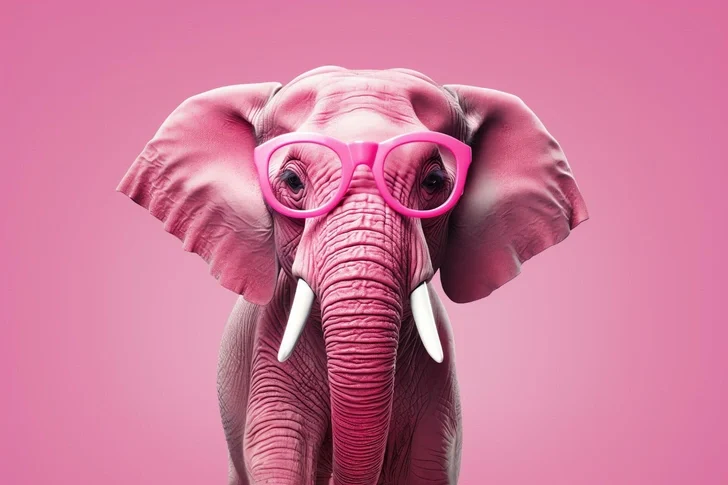
When we are asked not to think about a specific object, its image often immediately appears in our mind. However, scientists also identify people with aphantasia — they are unable to create mental images in their heads.
“Think about anything you want, but do not think about a pink elephant.”
What does your imagination show after hearing this phrase? Most likely a pink elephant in many different variations. And the more you try not to think about it, the more intrusive the image becomes.
Scientists from the University of Queensland in Australia proved in a new study that the pink elephant problem is not universal. Scientifically speaking, there are people in the world with Aphantasia, and their thinking works quite differently. When such a person tries to imagine a specific image, the brain simply does not allow it.
“When a person learns they have aphantasia, they often feel upset. They cannot visualize characters from books, while most of us are used to imagining what characters look like. Moreover, it may even be difficult for them to imagine the face of a loved one. And this is not related to memory problems,” scientists say.
In their research, scientists studied the relationship between the intensity of people’s visual imagination and their tendency to visualize images even when they try not to.
Volunteers were asked for five minutes not to think about a white bear, a pink elephant, or another animal. Every time their thoughts returned to it, they had to ring a bell. It turned out that participants with vivid visual imagination were more likely to experience involuntary visualizations, and researchers could predict these results by measuring brain activity.
People with aphantasia were actually able not to imagine the object at all. However, their minds did not remain empty — instead, their thoughts simply moved on to more practical and real things. For example, what they were going to eat for dinner.
For example, a girl named Lauren could not imagine hearing a sound or a conversation. She experiences her thoughts as different texture sensations, can imagine movement, but cannot imagine sound at all.
Scientists concluded that some people have excellent self-control. They could imagine an object, but consciously chose not to do so.
If you are among those who can control themselves well, you can try repeating the experiment.
What is the experiment?
It’s very simple. You need not to think about a pink elephant. Think about anything you want — but not about this animal.
Set a timer for 5 minutes and try to defeat your own brain.
Did you succeed? If yes, then you are very good at controlling your mind.
If you thought about the pink elephant 1–3 times, that is also a good result.
If your thoughts kept returning to the elephant constantly, then for now you are not fully able to control your stream of thoughts.
This exercise helps train willpower and direct your thoughts in the right direction. Try it! And here is the pink elephant for visualization and a good mood.