The dollar is more than just a unit of currency. It’s a global symbol — one that links the United States with the rest of the world. And yet, even the humble one-dollar bill hides layers of symbolism, history, and the occasional historical anecdote.
Today, six denominations circulate regularly: $1, $5, $10, $20, $50, and $100. The $2 bill, printed irregularly, exists somewhere between everyday money and cultural curiosity. There are also higher-value banknotes — $500, $1,000, $5,000, and $10,000 — last issued before 1946. While still technically legal tender, they now live mostly in private collections and museum displays.
All U.S. banknotes share the same dimensions — 6.14 × 2.61 inches — a standard introduced in 1928 along with a unified visual language for American currency. Among them, the one-dollar bill stands apart. Its design, finalized in 1935 by Edward M. Weeks, head of engraving at the U.S. Bureau of Engraving and Printing, is the most symbol-dense and ideologically charged of them all.
The front of the one-dollar bill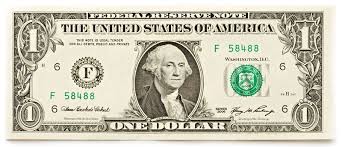
The back of the one-dollar bill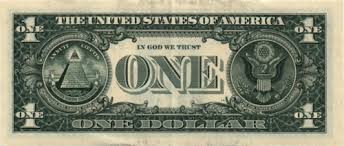
A Symbol of Power
Few graphic signs are as recognizable as the dollar sign — and few have inspired as many origin stories. Its exact beginnings remain debated, but several theories continue to circulate.
The patriotic explanation
One interpretation sees the symbol as a stylized US, with the letters overlapping. As they merge, the curve of the U disappears, leaving behind two vertical lines. Traditionally, the dollar sign was written with two strokes, though modern usage often favors a single line.
The Spanish connection (three versions)
The peso and the “piece of eight.”
The Spanish peso, also known as the Spanish dollar, equaled eight reales and was worth one-eighth of a British pound — hence the famous piece of eight. Early shorthand depictions resembled an eight crossed by a vertical line, gradually morphing into the symbol we know today.
The Pillars of Hercules.
A similar image appeared on Spanish silver coins as part of the royal coat of arms, showing the Pillars of Hercules — the mythic gateway to the Strait of Gibraltar — often framed by a banner.
A typographic shortcut.
In written records, the word peso was abbreviated as a capital P, with a small s added above it in the plural. By the 18th century, the characters merged, leaving only the vertical stroke behind.
The uncomfortable theory
A more troubling version links the symbol to slave-trade accounting. According to this interpretation, restraints resembling an S-shape were used on enslaved people. In Spanish, esclavo means slave, and clavo means nail. The symbol $ may have been used in ledgers to mark enslaved individuals — a reminder that even familiar symbols can carry dark historical echoes.